Baby Wildlife
Spring is a time of renewal, including for PEI’s wildlife. Early breeders such as Coyotes, Foxes, and Ravens have their young now, and others such as Snowshoe Hares, Striped Skunks, and Red Squirrels will follow soon. Our migratory birds are also returning and will make starting a family job one.
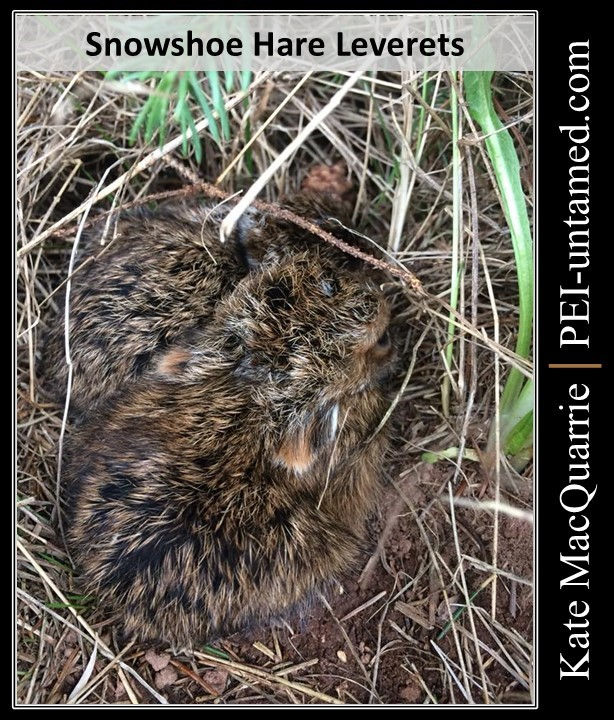
This is an important time of year for wildlife, but it’s also the time of year when well-meaning people can do the most harm. Seeing young animals in spring and summer is normal and does not mean they need to be ‘rescued’. For example, these baby Snowshoe Hares (called ‘leverets’) are not abandoned and do not need help.
Female hares leave their young alone during the day both to feed and to avoid attracting predators; the mothers return to their young at night to nurse. The leverets are well-camouflaged and remain motionless to avoid attracting unwanted attention. I suspect they also have very little scent, as my dogs often pass right by leverets without noticing them. The young hares’ only real defence is to freeze when danger is around and hope to go unnoticed.
Unfortunately, this makes it very easy for people to pick up these seemingly abandoned young. Not only does this needlessly remove animals from their home and their mother, but it also places incredible stress on the leverets, who can’t tell a misguided human from a predator. Leverets (and other young wildlife) aren’t staying still to allow you to pick them up; they are terrified, to the point that some die just from being handled.
While you may come across young mammals in mid- to late spring, fledgling birds start to appear in summer. As part of their normal development, birds that aren’t quite ready to fly will jump from branch to branch and spend time on the ground learning how to find food. Just like leverets, these young birds are under the care of their parents and don’t need our help.
It's natural to want to help wildlife. Unfortunately, rescuing young animals is rarely necessary and – like feeding or relocating – usually does more harm than good. While we may not like it, nature doesn’t follow our rules: high percentages of some species’ young die naturally and end up as food for other wildlife. This is as it should be and is the reason these species produce large numbers of offspring.
Too often, the things we do to try and help wild animals are more for our benefit than theirs. The best ways to truly help wildlife are to leave them alone and give them the space they need to be wild. It’s important to keep these parts of PEI Untamed!