Horse Flies
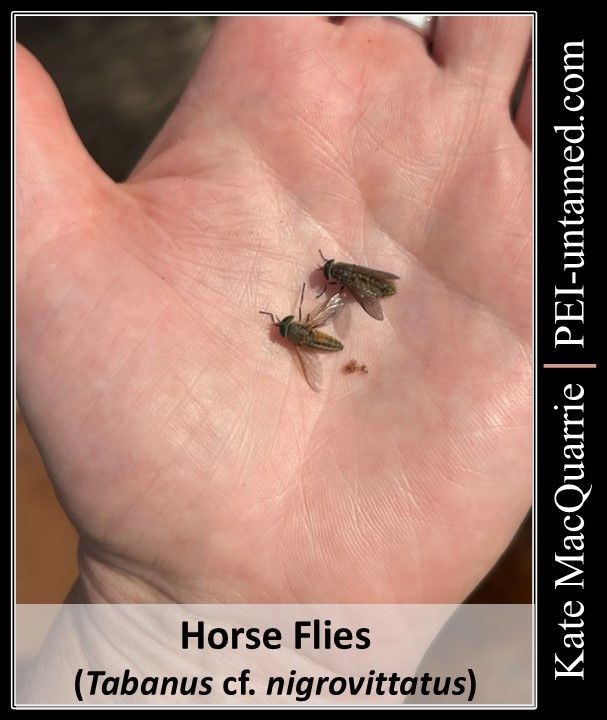
I would have liked a better-composed and more in-focus photo of today’s PEI animal, but I was under attack by a hoard of these fierce creatures. If you’ve met them, you know what I mean: these are Horse Flies (Tabanus nigrovittatus or similar).
The names Horse Fly and Deer Fly are often used interchangeably for any large, biting fly, but they are two different, albeit related, beasts. Horse Flies and Deer Flies are in the same family (Tabanidae), but Deer Flies (Chrysops spp.) are smaller (less than 12 millimetres [1/2 inch]), have dark spots or bands on their wings, and tend to buzz around your head, neck and shoulders (Horse Flies target legs and ankles).
The size and unmarked wings of the pair shown here – not to mention the bites on my legs! – confirm their identity as Horse Flies; the colour, stripe down the abdomen, and large green eyes suggest that they’re Saltmarsh Greenhead Flies, or a similar species.
If you’ve encountered Horse Flies, you’re probably more interested in deterrence than identification. Female Horse Flies (and Deer Flies) feed on blood, a protein-rich meal which provides the energy needed for egg laying. Unlike Mosquitoes, whose needle-like mouth parts pierce but don’t really hurt, Horse Flies’ mouth parts are knife-like, tearing into skin so the fly can lap up the resulting blood. When a Horse Fly bites, you know it!
PEI has a dozen or so species of Horse Flies, and they are most common around saltmarshes, freshwater wetlands, and wet woodlands. However, Horse Flies can travel several kilometres (a couple of miles) and so you can find them pretty much anywhere on the Island. Avoidance isn’t practical, but options for deterrence include physical, chemical, and biological.
I find a tightly-woven long-sleeved shirt and jeans offers the best protection: if the fabric is strong enough, Horse Flies can’t bite through. You can try repellents containing DEET or Icaridin, though in my experience Horse Flies just laugh at those. Dragonflies are natural predators of Horse and Deer Flies, and a clip-on Dragonfly decoy can deter the insects.
Adult Horse Flies are important prey for other species, the males are pollinators, and Horse Fly larvae feed on (and so help control) various invertebrate species. While we may not appreciate them, Horse Flies are common and native parts of PEI Untamed!