
Common Comfrey
There are some PEI plants that, when I find them, suggest there was once a homestead nearby. Wild Apples and abandoned Lilacs are two examples, but so too is Common Comfrey (Symphytum officinale).
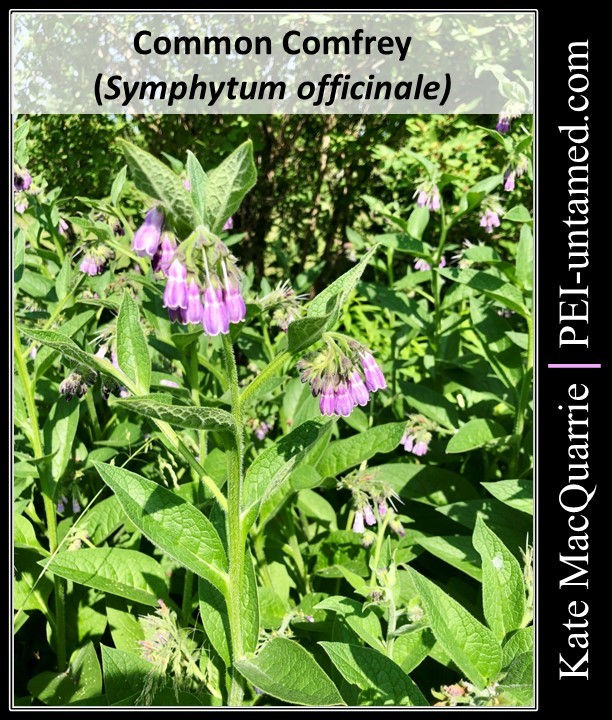
Comfrey is native to Europe and parts of Asia and was brought to North America as a medicinal and ornamental plant in the 1600s. This plant’s name attests to its long history of medicinal use: Symphytum is from ancient Greek words meaning ‘unite’ and ‘a plant’, while officinale was a Latin name given to plants with well-established medicinal uses. Even the common name Comfrey has its roots in the Latin for ‘grow together’, and this plant is also known as Boneset and Knitbone. All of these names point to Comfrey’s traditional use in healing wounds, strains, and sprains. Modern research confirms its ability to speed wound healing and relieve muscle aches and pain.
While Comfrey has been in North America for centuries, it’s a relatively new arrival to PEI. In the 1950s, Comfrey was known from only a couple of locations, and David Erskine suggested those might actually have been Prickly Comfrey (Symphytum asperum – that species difference is important, as we’ll see in a moment). Regardless, Common Comfrey is definitely here now and can be found growing wild in all three counties.
Medicinal use of Comfrey in Canada has been controversial since at least the 1980s, when the Federal Government banned drugs containing Prickly Comfrey and Russian Comfrey (a hybrid of Common and Prickly). Additionally, all species of Comfrey other than Common Comfrey are banned for use in cosmetic products in Canada, and Common Comfrey may be added to the prohibited list this year.
The concern is a group of chemicals called pyrrolizidine alkaloids (PAs for short) which can cause liver damage and cancer; among these, the PA echimidine occurs in high amounts in some species of Comfrey. Common Comfrey had been considered echimidine-free, but newer research suggests some plants may have this PA. Proponents of Comfrey argue it has been used safely for thousands of years, while detractors note evidence of health risks, including cases of human harm, from using Comfrey.
If you are going to use Comfrey medicinally, external is safer than internal (although echimidine can be absorbed through skin), leaves are safer than roots, and Common Comfrey, shown here, is safer than the other species. A key identification feature for Common Comfrey is the way the base of each leaf extends down the stem to the leaf below; leaves of our other Symphytum species don’t do this.
In addition to medicinal uses, Comfrey is also useful as liquid fertilizer for vegetables, fruit trees, and flowering plants. Called Comfrey tea, it’s usually made by allowing Comfrey leaves to decompose in a bucket (with or without added water) for several weeks; the resulting liquid can be strained, stored, and diluted for use as fertilizer when needed. Chopped Comfrey leaves can also be added directly to your compost pile, mulched into soil, or scattered around your garden to add nutrients, especially nitrogen, phosphorus, potassium, and calcium.
Although not native, Comfrey is an interesting and useful part of PEI Untamed!


