
Starry False Solomon's Seal
When we think about wildflowers, coastal areas often get overlooked in favour of fields, forests, and roadsides. But that means missing some of PEI’s loveliest native plants, including Starry False Solomon’s Seal (Maianthemum stellatum).
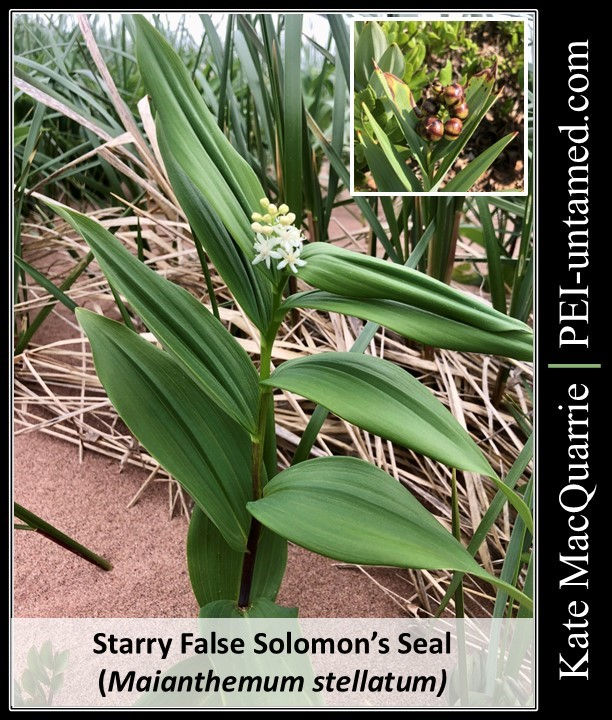
Starry False Solomon’s Seal is a relative of Wild Lily-of-the-Valley, which I introduced you to earlier this spring. If you guessed these plants are members of the Lily Family (Liliaceae), you’d be sensible, but wrong! The genus Maianthemum has recently been moved to the Asparagus Family (Asparagaceae) on the basis of DNA analysis. I understand why this was done but, as a botanist, I’m not a huge fan of classification based on DNA rather than morphology: when identifying a plant in the field, I can see how it looks, but I can’t see its genetics.
This plant does look lily-like, with long, parallel-veined leaves arranged alternately on the stem, flowers with six petal-like structures (called ‘tepals’), and fleshy berries that appear in late summer. Those berries are particularly striking, starting out green-and-brown striped (inset photo), before maturing to dark red. Starry False Solomon’s Seal is found in every province and territory in Canada, except Nunavut. While I’ve only ever found it around coastal sand dunes on PEI, this plant does grow in forests and grasslands elsewhere in its range.
In western North America, Starry False Solomon’s Seal has been used traditionally for food (ripe berries) and medicine (roots were used internally for stomach issues and externally for wounds and skin issues, among other things), although there is less evidence that this was the case here in the east. It may be that the plant’s preference for coastal habitats made it less common – and thus less commonly used – in our region. Regardless, Starry False Solomon’s Seal is ranked as S3 (vulnerable) on PEI; that status, coupled with its sensitive sand dune habitat, means this is not a plant I recommend foraging.
Like many plants that grow in challenging habitats, Starry False Solomon’s Seal forms partnerships with mycorrhizal fungi. The fungi provide the plant with nitrogen and phosphorus (helpful when growing in nutrient-poor, sandy soils) in exchange for carbohydrates (sugar) the plant makes via photosynthesis. Starry False Solomon’s Seal – and its fungal partners – are beautiful and native parts of PEI Untamed!


