Red-mouth Bolete
I love meeting a new-to-me mushroom, and so was quite happy when I found these among my favourite patch of King Boletes (aka Porcini) last week. Meet the aptly named Red-mouth Bolete (Neoboletus subvelutipes).
Followers of this page will know that mushrooms with spongy pores rather than gills, folds, or teeth under the cap are boletes. (Not all boletes have spongy pores, but mushrooms that do are boletes. And if you haven’t been following this page, you can get caught up on the more than 60 types of wild PEI mushrooms I’ve featured to date by visiting the "Fungus Profiles" section of this blog). Key clues to bolete identification include the colour of the cap and pores, colour and any pattern on the stem, whether the mushroom changes colour when cut or bruised, and habitat.
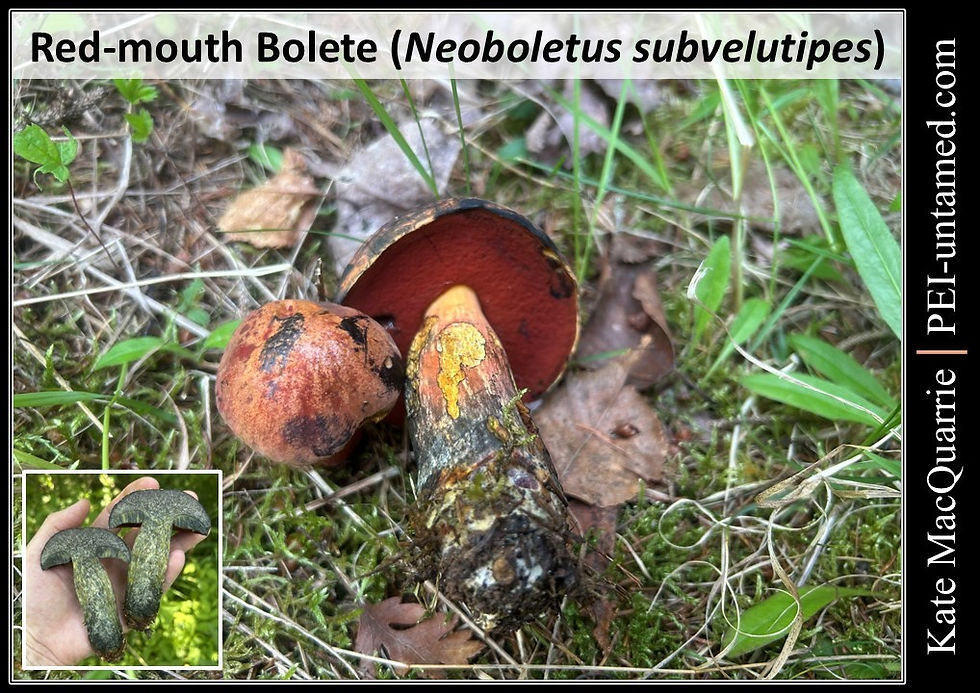
Red-mouth Boletes have caps that are reddish-brown to brownish-yellow, along with orange-red pores (main photo). The stem is coloured similarly to the cap and has no significant pattern – no netting (reticulation) like King Boletes, or dark spots (scabers) like Scaber Stalks. But Red-mouth Bolete’s most dramatic feature is its colour change: cut this mushroom open and the yellow flesh instantly turns blue (inset photo). That’s not unique to this species, but if you have a reddish pored mushroom that instantly stains blue when cut or bruised and lacks any reticulation on the stem, you likely have a Red-mouth Bolete.
Boletes are often mycorrhizal – forming mutually-beneficial relationships with the trees around them – and so knowing what your mushroom was growing with often helps with identification. Red-mouth Boletes don’t seem to be very choosy and can be found under both hardwood trees and conifers (these were under old field White Spruce). It may be that this mushroom is indeed a generalist, or that several similar-looking fungi are grouped together as Neoboletus subvelutipes and future genetic analysis will separate them.
Some sources say that blue-staining boletes are not edible, but that’s a myth. While there are toxic blue-staining boletes, Red-mouth Boletes are edible when thoroughly cooked. Like many foods, these mushrooms don’t agree with everyone, so – once you are sure of your ID – try a small, well-cooked amount before digging into a big feed.
The Island has hundreds (possibly thousands!) of species of fungi that are beautiful and ecologically important members of PEI Untamed!